Guide · Buying guide
Nasal strips for running: how to choose
Disclosure: We make sport nasal strips. This guide explains how to judge any nasal strip for running, ours included, based on published research.
Quick answer
For running, choose an external nasal strip in the right size for your nose, with an adhesive made to hold through sweat, and test it in training. Strips reliably reduce nasal resistance, which makes nose breathing feel easier, but research doesn't show a consistent performance gain, so choose them for comfort. They're drug-free and not intended to treat snoring or sleep apnea.
- Fit matters most: a band that's too long lifts at the ends; one that's too short doesn't open the nose.
- Sweat is the main reason strips fall off during exercise; choose an adhesive made for sport and apply to an oil-free nose.
- Strips reduce nasal resistance; a 2020 systematic review found no significant effect on VO2max, heart rate or perceived exertion.
- External nasal dilators are Class I devices under 21 CFR 874.3900; Class I devices are not FDA approved.
Quick checklist
| Look for | Why it matters |
|---|---|
| Right size | The band should sit flat across the nose with both ends on the flat sides above the nostrils |
| Sport adhesive | Sweat and skin oil are what lift strips during runs |
| Spring strength | Enough lift to open the nasal passages without discomfort over a long session |
| Skin-friendly | Remove with warm water; avoid if you react to adhesives |
| Color | A matter of preference; black reads as sport gear, clear is less visible |
| Drug-free | External strips work mechanically; there's nothing to inhale or swallow |
What strips can and can't do for runners
External nasal dilators are described in US regulation as devices that decrease airway resistance and increase nasal airflow.[1] During exercise, studies show they lower nasal resistance and the work of nasal breathing, though not everyone responds.[2] A 2020 systematic review of 19 studies found no significant effect on VO2max, heart rate or perceived exertion,[3] and a 2022 meta-analysis found only small effects with very low certainty.[4] Choose strips because nose breathing feels easier, especially on easy and moderate runs, not to run faster. See the full research summary.
How to get the fit right
- Find the spot just above the flare of the nostrils, below the hard bony bridge.
- If the ends sit on the cheeks or curl up, the strip is too long; if the band barely reaches the sides of the nose, it's too short.
- Wash and dry the nose first; sunscreen and skin oil weaken the hold. Apply sunscreen around the strip, not under it.
- Try it on a training run before a race.
Who should skip them
Don't use strips on sunburned, irritated or broken skin, or if you react to adhesives. Strips are not intended to treat snoring or sleep apnea; loud snoring or pauses in breathing during sleep are reasons to see a doctor.
Where MILEPROOF fits
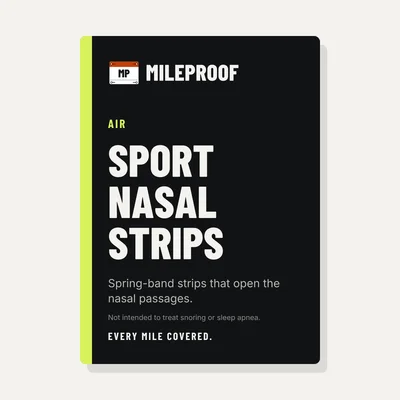
MILEPROOF Sport Nasal Strips are black, sweat-resistant external nasal strips made for exercise, in sizes. They launch on Amazon US and TikTok Shop US in January 2027.
FAQ
What are the best nasal strips for running?
Ones that fit your nose, hold through sweat and feel comfortable over a long run. Test a strip in training; research doesn't show that any strip improves running performance.
Do nasal strips help you breathe better when running?
They reduce nasal resistance, so many runners find nose breathing easier. They haven't been shown to improve VO2max or race times.
Are nasal strips allowed in races?
Generally yes. They're drug-free and mechanical; check your event's athlete guide for equipment rules.
Sources
- 21 CFR 874.3900 Nasal dilator. US Code of Federal Regulations (eCFR).
- Nasal resistance and flow resistive work of nasal breathing during exercise: effects of a nasal dilator strip. Gehring et al., Journal of Applied Physiology, 2000.
- Does the external nasal dilator strip help in sports activity? A systematic review and meta-analysis. Dinardi et al., European Archives of Oto-Rhino-Laryngology, 2020.
- Nasal dilator and physiological parameters associated to running performance. Gomes et al., Journal of Sports Sciences, 2022.